Most struggling spas are not short on effort. They are short on rules: the menu grew by accretion, prices came off a competitor's website three years ago, and nobody knows what a liter of massage oil costs per treatment.
What managing a spa business actually involves
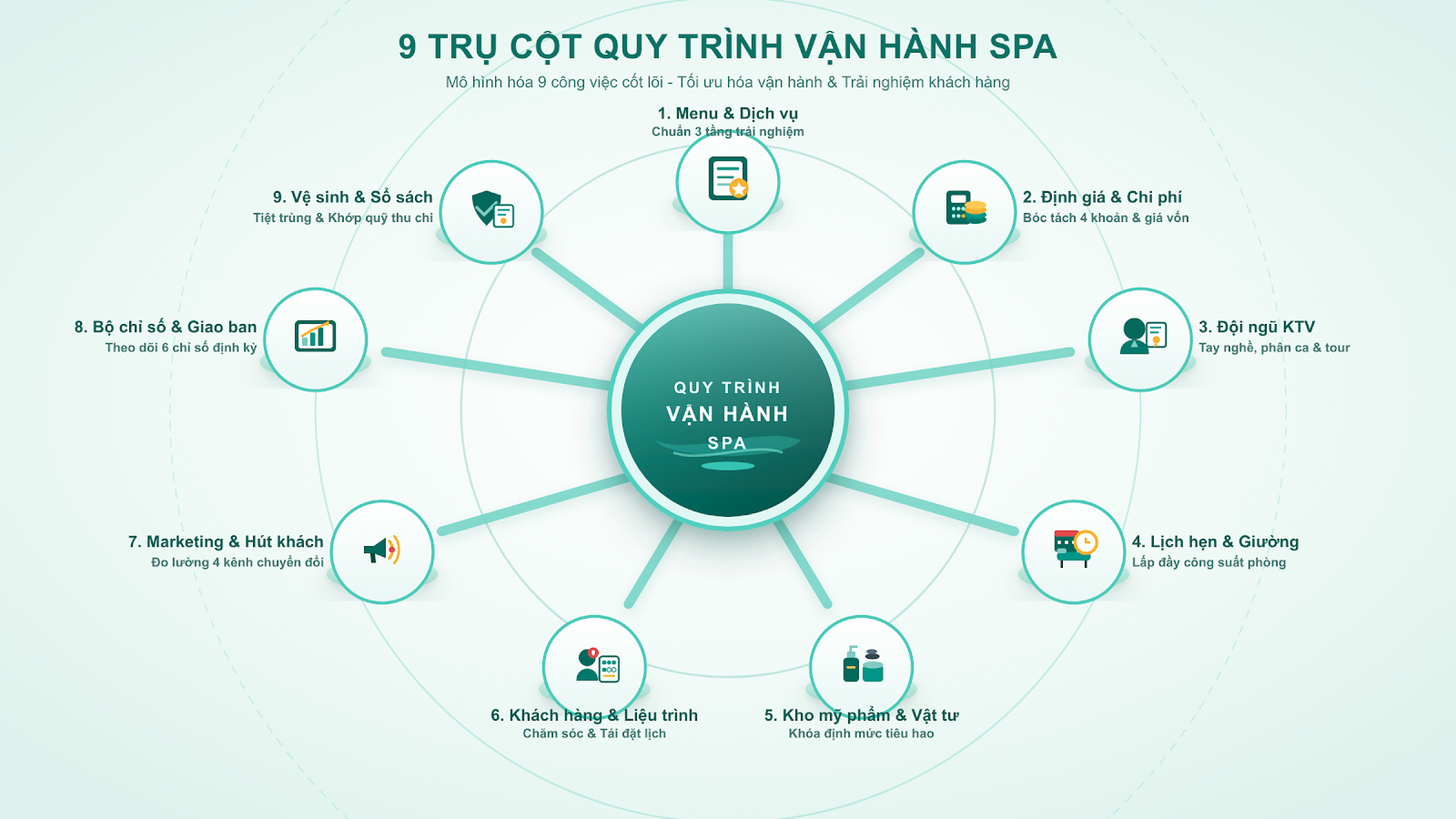
Ask ten owners how to manage a spa business and you get ten answers. Operationally there is one: a manager owns eight systems and the numbers that report on them. Every crisis, callout, and double-booked room is a symptom of one being undefined.
- Service menu — what you sell, and how much of it.
- Pricing — what each item costs to deliver, and what it must sell for.
- Staff — who you hire, how you train them, how you pay them.
- Schedule — matching paid staff hours to booked service hours.
- Inventory — product consumed in treatments, and product sold.
- Client retention — how reliably a first visit becomes a fourth.
- Marketing — filling quiet hours without discounting busy ones.
- Compliance — hygiene, licensing, insurance, client data.
Change one rule — a cancellation window, a duration standard, a par level — and you have fixed that problem for every future booking. Owner-therapists get stuck because forty hours on the table pays immediately and consumes exactly the hours those systems need.
Design a service menu you can actually deliver
A workable spa menu is small enough that every therapist on your roster can deliver every item to the same standard. That test prevents most menu problems, because each added service brings a training path, new SKUs, a new duration, and another front-desk script — costs that never appear as a line item.
How should you structure a spa treatment menu?
Three tiers, and nothing outside them:
- Core treatments — the revenue spine. Six to ten items every therapist is certified in. These fill the book.
- Add-ons and upgrades — 15 to 30 minutes, high margin, low setup: scalp massage, eye treatment, peel upgrade, hot stones.
- Packages and series — bundles of core treatments, priced to buy frequency rather than volume.
How do you match treatment duration to capacity?
Standardize your durations. Three lengths — say 30, 60, and 90 minutes — plus a fixed turnover block for room reset, and your day becomes a grid you can fill. Add a 45-minute facial and a 75-minute massage and it fragments into 20-minute orphan gaps: too short to sell, too long to ignore.
Run the cull annually: any item that misses a minimum quarterly booking count gets promoted properly or removed.
Price treatments for margin, not for comparison
Price from your costs upward, not from the spa down the street downward. A competitor's price tells you nothing about whether it covers your therapist, product, and room.
Four things make up the cost of a treatment: the therapist's paid time including payroll burden, the product consumed, an allocation of fixed cost for the occupied room hour, and card fees. Add them and you have a floor price. Below it you are paying for the privilege of being busy.
Floor price = therapist cost + back bar cost + allocated room cost + transaction fees
Menu price = floor price ÷ (1 − target gross margin)
How do you work out the true cost of a spa treatment?
The room allocation is the part most owners skip. Divide monthly fixed costs — rent, utilities, insurance, front-desk wages, software, loans — by the room hours actually available. That gives you a cost per occupied room hour to apply by duration.
Illustrative example, not a benchmark. A 60-minute massage at a hypothetical spa, in USD:
| Component | Calculation | Cost |
|---|---|---|
| Therapist time | $28/hr fully burdened × 1 hr | $28.00 |
| Back bar product | 30 ml oil, linens, disposables | $3.50 |
| Room and overhead | $12,000 monthly fixed cost ÷ 600 available room hours | $20.00 |
| Card and booking fees | ~3% of a $110 sale | $3.30 |
| Floor price | $54.80 |
At a 55% target gross margin, the indicated menu price is roughly $122. Sell it at $110 and gross margin is $55.20, about 50% — still defensible. Selling at $85 is not, because the room-hour cost does not shrink when you discount. Run the same build-up per duration: longer treatments need proportional pricing, not a volume discount.
Two rules follow. Raise prices a whole tier at a time, once you have absorbed cost increases for two quarters or peak slots are full a week out. And treat prepaid packages as a liability, not profit — model packaged margin against your floor price, and let discounts buy frequency rather than volume.
Hire, train, and pay your team so performance is predictable
Predictable performance comes from two things: a defined onboarding path, and a pay model whose incentives match the behavior you want. Motivation is not a system.
What should you hire for — skill or reliability?
Technique can be trained in weeks. Reliability, the instinct to rebook, and comfort talking about home care are harder to install. Screen for those with a paid trial shift and a treatment test on an existing staff member, who reports back on pressure, pacing, and room manner. A certificate tells you what someone completed, not how they handle a late, irritated 6 p.m. client.
What does a 30/60/90 day spa onboarding plan look like?
- Days 1–30: hygiene and sterilization SOPs, opening and closing routines, your booking and POS system, product knowledge, shadowing. No solo bookings on complex services.
- Days 31–60: solo delivery of two or three core treatments, with weekly review of treatment notes — notes show clinical thinking, not just technique.
- Days 61–90: full core menu plus add-ons, explicit rebooking and retail expectations, and a first utilization review framed as diagnosis.
Write it down once and it works for every hire after.
Should you pay spa therapists hourly, on commission, or a hybrid?
Three models, three different failure modes.
| Hourly | Commission | Hybrid (base + commission) | |
|---|---|---|---|
| Who it suits | New spas, unpredictable demand, lots of non-treatment work | Established books, therapists with a personal clientele | Most 1–5 location spas, mixed experience levels |
| Upside | Predictable costs; staff do laundry, training, and admin without resistance | Labor cost flexes with revenue; strong performers stay | A pay floor that reduces churn, with upside for production |
| Main risk | You pay for empty hours; no incentive to rebook or sell retail | Income swings drive turnover; resistance to non-billable work | Complex to administer; a base set too high kills the incentive |
| Effect on the schedule | You must fill hours or absorb the cost | Therapists fill their own columns | Balanced, if the base carries a productivity expectation |
Employment classification, minimum pay rules, and how commission may be calculated vary by country and state. Confirm specifics with a local employment adviser before you write a contract.
How much should spa payroll be?
Watch the ratio, not the rate. The salon and spa consultancy Strategies puts the service-payroll benchmark at 30% to 35% of total revenue, defined as service plus retail sales — consultancy guidance, not a regulated standard, but a useful ceiling.
Service payroll % = service payroll ÷ total revenue × 100
That is not the same as an individual commission rate. A therapist on 40% commission with a full column can still leave the ratio inside the band; the same therapist with a half-empty column is a problem, and the ratio is where you see it.
Run the schedule so you stop leaking hours
Utilization decides whether your spa is profitable at its current headcount. It is the fastest number to move, and the one most owners cannot state for last week.
Utilization rate is the share of paid staff hours actually booked with revenue-earning service time.
Utilization rate = booked service hours ÷ available staff hours × 100
How do you calculate spa therapist utilization?
Take one therapist and one week. She is paid for 40 hours, 5 of them admin, laundry, and deep-clean blocks, so available service hours are 35. She delivered 21 treatment hours.
- Against available hours: 21 ÷ 35 = 60%
- Against paid hours: 21 ÷ 40 = 52.5%
Both are correct; they answer different questions. The trap is comparing your 60% with someone else's 52.5%. Pick one denominator and keep it.
For orientation, Zenoti's 2026 Beauty & Wellness Benchmark Report — one vendor's client base, not an industry census — puts spa staff utilization at a 47% median for non-membership businesses, 62% at the 75th percentile and 76% at the 90th; membership spas sit at 42%. Your own twelve-week trend matters more. Room utilization works the same way but has no reliable published benchmark.
Then staff to the shape of demand. Chart twelve weeks of bookings by weekday and hour, stagger start times to match demand rather than the clock, and push laundry, restocking, and training into the troughs. Off-peak pricing on a quiet morning is incremental margin, not a discount; at the edges, use float therapists rather than a column you cannot fill.
How do you reduce no-shows at a spa?
Five controls, applied consistently:
- A written cancellation window (commonly 24 or 48 hours) stated at booking, not discovered afterward.
- Card on file or a deposit for long, high-value, or first-time bookings.
- Two-step reminders: confirmation, then 24–48 hours out with one-tap rescheduling.
- A same-day waitlist, so a cancellation gets refilled.
- Actual enforcement. A policy you waive on request is a suggestion.
The same Zenoti data shows who cancels: 9% for clients who had never rebooked, 23% for those who had rebooked once, and 2% for those who had rebooked twice or more. The second rebooking is where a client becomes reliable, which makes rebooking a scheduling control, not just a retention tactic. Non-membership spas there also took a median 29% of bookings online, and the top decile 58%.
Manage inventory as two separate businesses
Back bar is a cost to control. Retail is a revenue line to grow. Managed in one bucket called "product," both get worse.
Back bar is professional product consumed during treatments and never sold — oils, masks, wax, disposables. Retail is product sold to clients to take home.
How do you control back bar cost?
Measure it per service, not per month. A monthly total tells you what you spent; a per-service cost tells you if you are efficient.
Back bar cost per service = product cost per unit ÷ services per unit
Illustrative example. A one-liter bottle of massage oil costs $60. At 30 ml per treatment it covers about 33 treatments — roughly $1.80 per service. Let therapists free-pour to 40 ml and it covers 25, so the cost becomes $2.40. That 33% jump is invisible in a monthly total, which just looks like a busier month.
Controls that fix it: pump dispensers with a measured stroke, pre-decanted portions, one locked storage point, and per-therapist usage visibility.
What should spa retail contribute?
Give it a target. Kitomba, a salon and spa software provider, suggests retail should be 15% to 30% of total revenue — framed for salons, and vendor guidance rather than an industry standard, but a reasonable range.
Retail-to-service ratio = retail revenue ÷ total revenue × 100
The mechanism is prescription, not sales. The therapist who just spent an hour on a client's skin is the only person with standing to say what they should use at home. Written on the treatment card and passed to the front desk, it makes checkout a fulfillment step rather than a pitch.
How do you keep stock counts honest?
Set a par level — the quantity of each SKU you want on the shelf — and a reorder point that triggers a purchase.
Reorder point = average weekly usage × weeks of lead time + safety stock
Count on a fixed date monthly, back bar and retail separately, and investigate mismatches before adjusting.
Keep clients coming back
The highest-leverage retention action happens in the ninety seconds after a treatment ends: booking the next appointment before the client walks out.
Rebooking rate is the share of visits that end with the next appointment already scheduled.
Rebooking rate = visits ending with a future appointment ÷ total visits × 100
A client who leaves with a date on the calendar returns far more reliably than one who leaves with an intention. Make the ask a scripted part of checkout, and give the therapist a reason to make it: "your skin will be ready for the next step in about four weeks" beats "would you like to book again?"
The other half is the client record. Treatment notes, product history, pressure preferences, and the fact that she is getting married in June — read before the next visit — make a second appointment feel personal rather than transactional.
Retention is also carrying more load than acquisition: in Zenoti's 2026 platform data, non-membership spas saw new-guest visits fall 8% through 2025 while existing-guest visits rose 3%.
Loyalty programs and memberships need more design than this section allows. For rebooking scripts, win-back sequences, and loyalty mechanics, see our guide to increasing customer retention at your spa.
Marketing that works at 1–5 locations
At this size, marketing is two jobs: being findable locally, and speaking to the database you already own. Everything else is optional.
How do you win local search for a spa?
Claim and complete your business profile on the major maps and search platforms, then keep it accurate — hours, holiday closures, service categories, and real photographs of your rooms rather than stock imagery. Build the review request into checkout, and reply yourself, including to the unhappy ones. A calm, specific reply to a two-star review sells better than the five stars around it. Point the profile at a page where someone can book, not a contact form — most spa searches happen on a phone, outside business hours, and a form is where the booking dies.
How do you market to the clients you already have?
Segment before you send: lapsed 90+ days, single-visit clients, high-value regulars, and clients interested in a specific service. Off-peak offers go to the first two, never to regulars who already fill your Saturday at full price. Win-back messages need a reason to return — a new treatment, a therapist recommendation — not a reflexive 20% off. Gift cards, referrals, and partnerships are cheap and still work; track gift-card balances as a liability.
The KPIs that tell you the truth
If you want one measurable answer to how to manage a spa business: five numbers, reviewed on a fixed rhythm, tell you almost everything. Reporting on twenty metrics is the same as reporting on none.
Which five numbers should a spa owner watch?
- Utilization — are you paying for hours you are not selling?
- Rebooking rate — is today's traffic producing next month's?
- Average ticket — is each visit worth what it should be?
- Retail-to-service ratio — a business, or a display?
- Client retention rate — a bucket, or a sieve?
Average ticket = total revenue ÷ number of visits
An illustrative month: 320 visits producing $41,600 gives a $130 average ticket. Add one $18 add-on to a quarter of those visits — 80 add-ons, $1,440 — and it moves to about $134.50 with no extra clients and no price rise. Add-on discipline shows up in the P&L faster than almost anything.
Client retention rate = returning clients ÷ clients eligible to return × 100
What does good look like?
| Metric | How to calculate | Reference point | Source |
|---|---|---|---|
| Staff utilization | booked service hours ÷ available staff hours | 47% median, 62% at 75th pct, 76% at 90th; membership 42% | Zenoti 2026 Benchmark Report — one vendor's platform data |
| Average ticket | total revenue ÷ number of visits | $103 median, $185 top 10%; $144 median (membership) | Zenoti 2026 report — platform data |
| Retail-to-service ratio | retail revenue ÷ total revenue | 15%–30% of total revenue | Kitomba, a salon and spa software provider |
| Service payroll | service payroll ÷ total revenue | 30%–35% of total revenue | Strategies, a salon and spa consultancy |
| Rebooking rate | visits with a future appointment ÷ visits | No dependable benchmark — track your own trend | Method only |
For market context, the 2026 ISPA U.S. Spa Industry Study, conducted by PwC for the ISPA Research Foundation, put U.S. spa revenue at $23.5 billion in 2025, up 4.2%, across 191 million visits — an average of $123.10 per visit.
What should you review daily, weekly, monthly, and quarterly?
| Cadence | What you review | Decision it triggers |
|---|---|---|
| Daily (10 min) | Tomorrow's book, gaps, deposits, cash and card reconciliation | Waitlist calls, staff release, same-day promotion |
| Weekly (30 min) | Utilization by therapist, rebooking, no-shows, back bar outliers, add-on rate | Roster changes, coaching, reminder settings |
| Monthly (2 hrs) | P&L, payroll %, retail-to-service ratio, stock count, revenue by menu item | Price or pay adjustments, supplier switch, retail range |
| Quarterly (half day) | Menu cull, pricing review, staffing plan, supplier terms, hygiene audit | Menu changes, headcount, tier repricing, retraining |
The cadence is the point. A number reviewed once a year is a post-mortem; reviewed weekly, it is a control. What kills the habit is pulling utilization, rebooking, and average ticket by hand from three sources, which is why spa reports and analytics that update on their own survive a busy month better than a spreadsheet.
Hygiene, licensing, and insurance basics
Hygiene has to be a system that survives your busiest Saturday. Licensing rules differ by country, state, and city, so confirm yours locally rather than copying another spa.
What hygiene systems survive a busy Saturday?
Written opening and closing procedures, one page each, posted where the work happens. Single-use items wherever they exist. Documented cleaning, disinfection, and sterilization steps for every tool that touches a client, with the manufacturer's contact times. Clean and soiled linen routes kept separate. A signed log per room per shift, and one named person accountable each shift. The test: a new therapist should be able to execute it from the sheet without asking anyone.
What should you verify with your local authority?
This is general information, not legal advice. Requirements vary between jurisdictions. Verify each with your local licensing board, health authority, and insurer:
- Practitioner certification and scope of practice for every treatment on your menu
- Premises licensing and any inspection regime attached to it
- Health, safety, and sanitation standards for your treatment types
- Liability insurance, and whether it covers every service you sell
- Client data obligations — intake forms, consent records, treatment notes
Write down which authority governs each item and when each license renews.
When systems outgrow spreadsheets
Nothing about how to manage a spa business requires software. Spreadsheets stop working at trigger points, not at a revenue figure. If none of these apply, a diary and a good spreadsheet are fine.
- You run more than one location and the books do not talk to each other.
- You have more than about five service staff, so rostering and commission math take real hours.
- You carry back bar and retail stock and cannot separate them.
- You sell memberships, packages, or prepaid balances and have a liability to track.
- You cannot see the week's five numbers without an evening of data entry.
What a single system consolidates is the connection between them: booking, staff scheduling, point of sale, client records, inventory, and reporting sharing one record per client and one definition per metric. The value is not the feature list. It is that utilization, rebooking rate, and average ticket stop being a research project — which is what spa management software like spamini.com is built to do. Start with whichever system costs you most, and write the rule first.
Frequently asked questions
What is a good utilization rate for a spa?
Zenoti's 2026 Beauty & Wellness Benchmark Report — one vendor's client base, not an industry census — reports a 47% median for non-membership spas, 62% at the 75th percentile and 76% at the 90th. Comparisons only hold if both spas use the same denominator.
How should you pay spa therapists — hourly, commission, or hybrid?
Hourly gives predictable costs but no incentive to rebook or sell retail. Commission flexes labor cost with revenue but can cause income swings and turnover. A hybrid suits most small spas. The consultancy Strategies puts service payroll at 30%–35% of total revenue. Employment rules vary by country and state.
How do you reduce no-shows at a spa?
Publish a cancellation window at booking, take a card on file or a deposit for long and high-value appointments, send a confirmation plus a reminder 24 to 48 hours out with one-tap rescheduling, keep a same-day waitlist, and enforce it.
What is the difference between back bar and retail inventory?
Back bar is professional product consumed during treatments and never sold — oils, masks, wax, disposables. Retail is product sold for home use. Back bar is a cost of goods measured per service; retail is a revenue line measured against total revenue.
Do you need software to manage a small spa?
Not necessarily. A paper diary and a disciplined spreadsheet can run a single-room spa. Software earns its place at a trigger point: a second location, more than about five service staff, both back bar and retail stock, prepaid balances, or weekly numbers you cannot see without hours of data entry.
Sources
- International SPA Association / PwC — 2026 U.S. Spa Industry Study ("Big Five"): https://experienceispa.com/press-releases/powered-by-the-industry-it-serves-ispas-2026-big-five-statistics-show-steady-gains-and-enduring-strength/
- Zenoti — 2026 Beauty & Wellness Benchmark Report, spa segment: https://www.zenoti.com/thecheckin/spa-trends-2026
- Kitomba — retail share of revenue guidance: https://www.kitomba.com/blog/make-your-salon-profitable-with-retail/
- Strategies — "The Dirty Truth About Salon & Spa Service Payroll Costs": https://strategies.com/dirty-truth-salon-spa-service-payroll-costs